

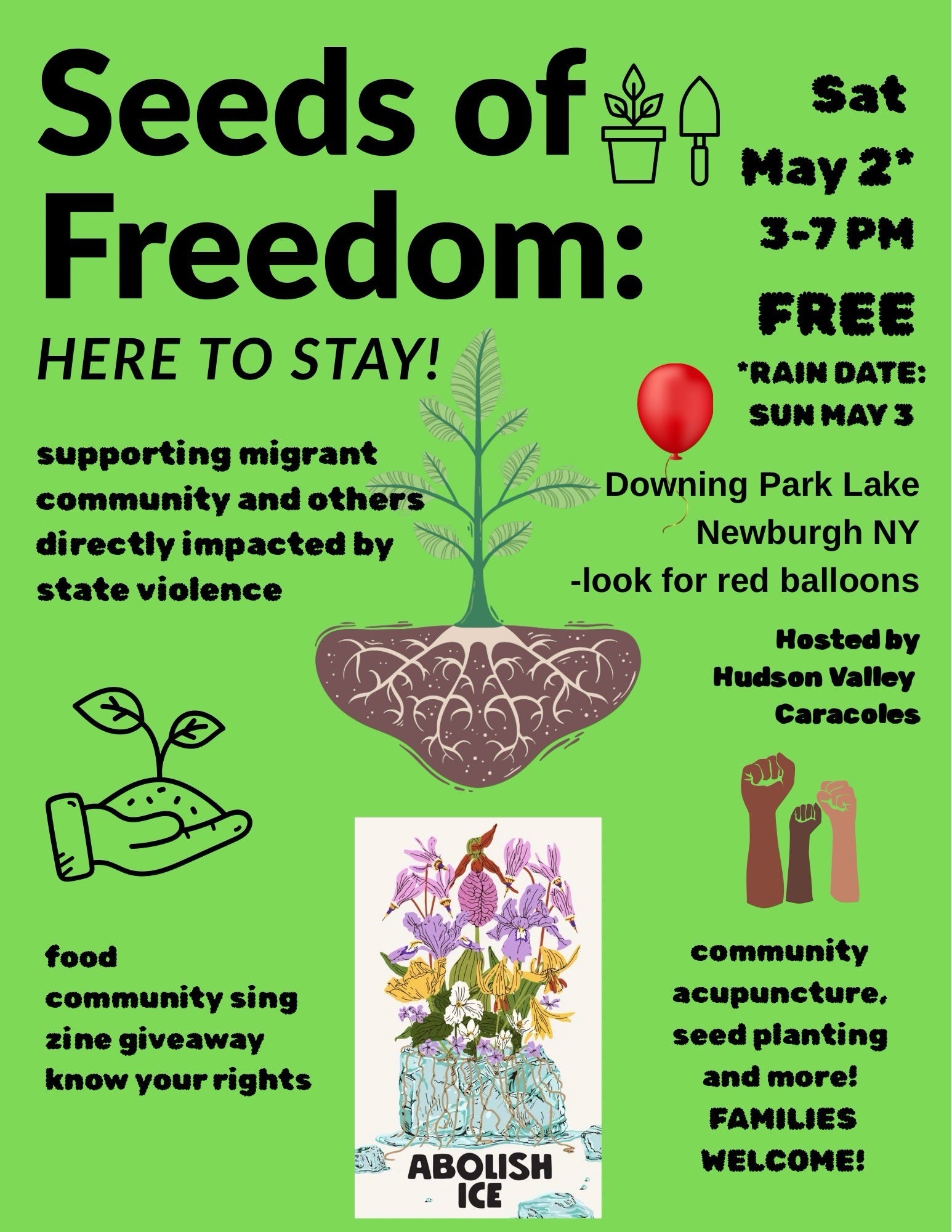
Pictured Above: A flyer for an event put on by a new local community group, Hudson Valley Caracoles. We’d like to encourage you to attend. Below, Little Dick Energy State Senator Skoufis tries to weasel out of supporting a bill he told numerous Orange County constituents that he supported. He’s not the only Democrat to do so, as you’ll see in today’s post.
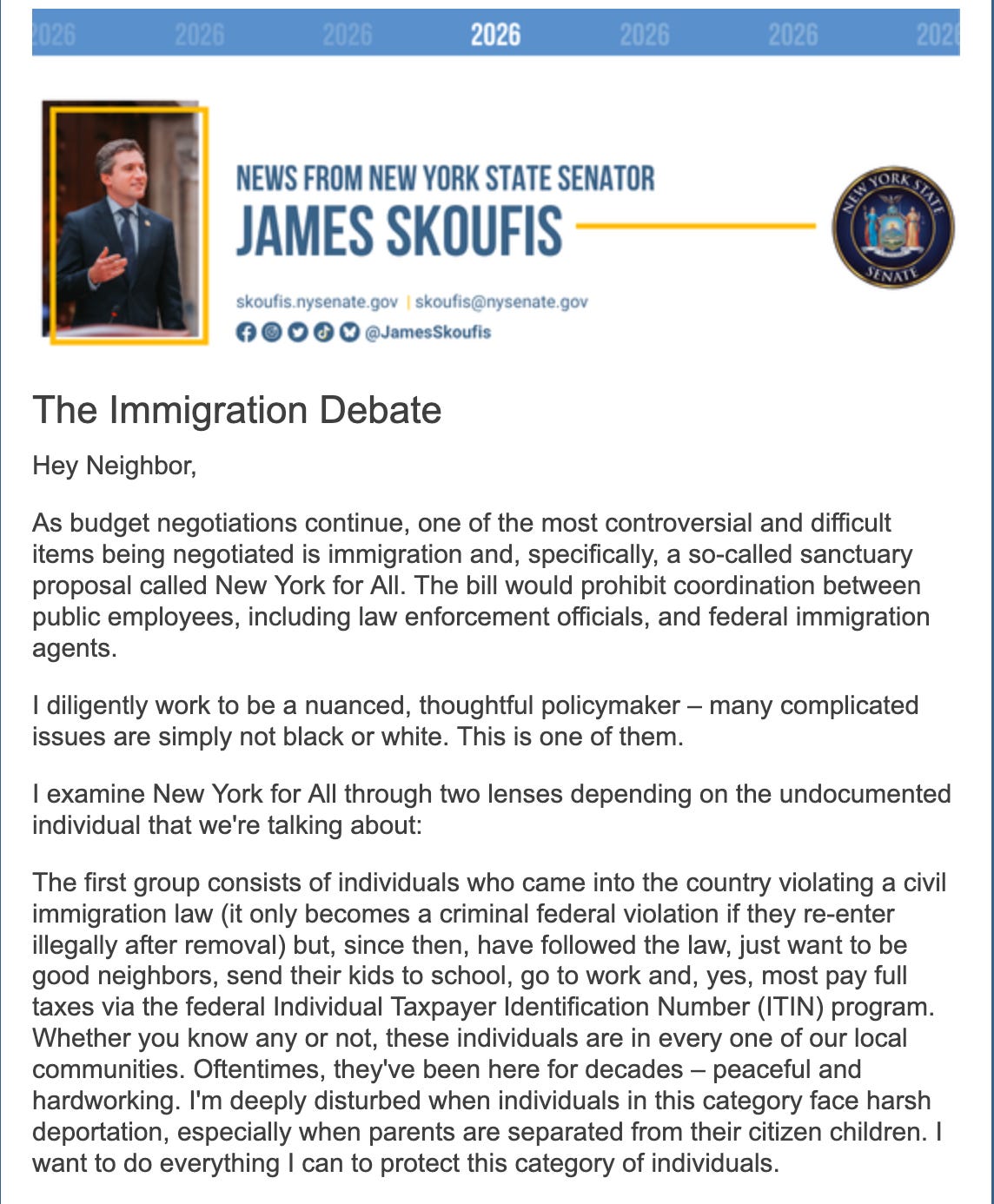
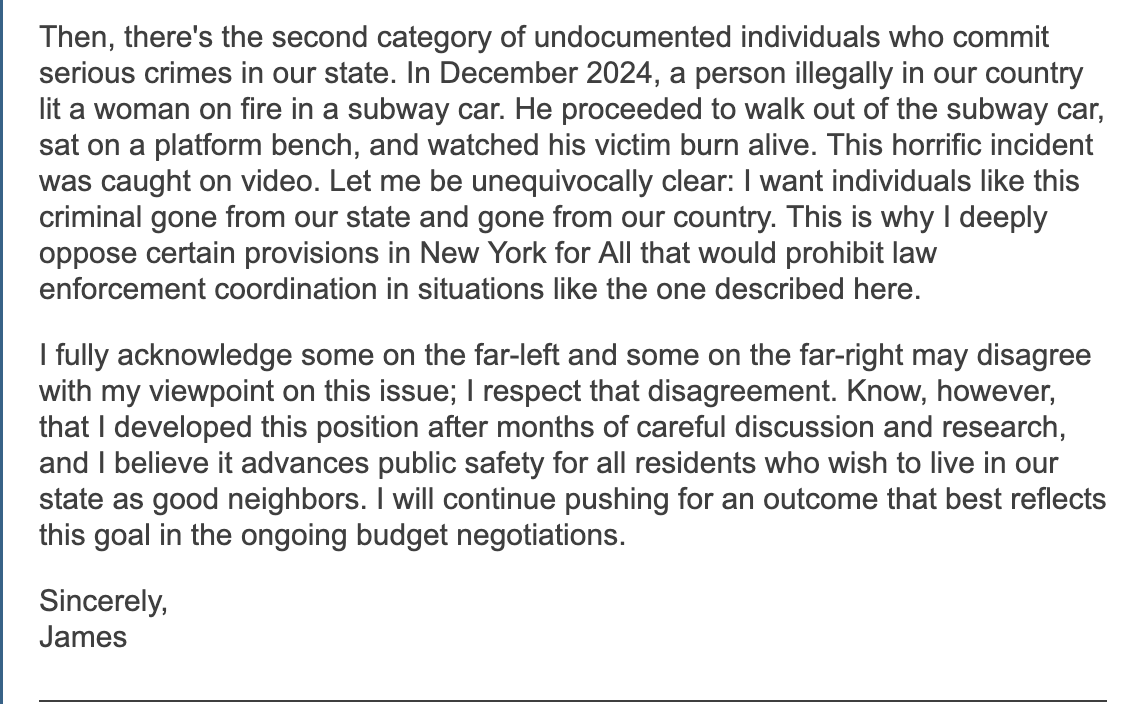
This man has no reproductive organs to speak of.
Yasmine Farhang, whom we spoke to in this podcast interview below, commented on the State Senator’s response, sharing with us:
Senator Skouffis’s attempt to rationalize his opposition to New York for All false flat. His rhetoric seeks to demonize New Yorkers by fear-mongering and mis-leading his constituents. He fails to recognize the beliefs that so many New Yorkers hold close - that the importance of keeping families and communities together is bound up with the importance of upholding due process for all. For years, ICE entanglement with state and local agencies has enabled the cruel separation of family members across our state - this includes many people who face disproportionate policing, as well as those who are convicted of crimes and serve prison sentences only to then face a cruel double punishment when funneled to ICE detention and deportation. The bottom line - New York resources must not be used to fuel a federal mass deportation agenda, especially when sending people to ICE is increasingly deadly. I reject Senator Skouffi’s attempt to divide us and we will continue to stand united in calling for New York for All.
The transcript below has been lightly edited for clarity and brevity. There may be errors as it was generated by an AI and read over by BJ, who usually misses a ton of typos on the first read through.
BJ Mendelson, Editor of The Monroe Gazette: Hello everyone, welcome to another edition of The Monroe Gazette podcast. I’m your host, BJ Mendelson. We have two interviews to bring to you today. Both are related to New York for All and some of the activity going on in our community to promote bills such as New York for All and Dignity Not Detention
I just wanted to say something real quick. So I am working on finishing my book, How to Protect Yourself from Fascists and Weirdos. It was supposed to be out in February. We basically went and ripped up the whole thing after Alex Pretti was murdered. I thought about doing it after Renee Good was killed, then when Alex Pretti was murdered, we got pushed over the threshold of … You know, needing to redo the entire book. So we rewrote it. We rewrote the entire thing. So it’ll be out. It looks like the end of May. I need to do a lot of stuff to get it ready.
This is all a long way of saying that May is probably going to be a quiet month on the Monroe Gazette, just so that I can get the book out. My expectation is that things will be fairly quiet until about May 15th. At that point, I will be done. And then other people will hopefully get involved and finish up the actual production of the book and then I can move on to other things. And then at that point, I’ve been thinking of doing some major changes to the The Monroe Gazette
Originally we had two goals. And the first goal was get Tony Cardone out of office, which we succeed in doing. And then the other goal was to sort of document everything that’s happening in South Blooming Grove and try to bring Joel Stern and Isaac Eckstein to justice.
So, I mean, we filed three lawsuits so far, and that’s not counting the federal one involving the stolen election. And it doesn’t involve the one with like the 26 residents who are going to file suit to have the village actually audited, because there’s no way Thomas DiNapoli, in an election year, is ever going to release that South Blooming Grove audit. So we figured we were going to sue.
My expectation is to focus on South Blooming Grove and then what’s going on over in Sullivan County with Kiryas Skever.
I can’t cover everything. And so there’s, there’s a certain like Maginot Line. I don’t know how many of you know what the Maginot Line but like the Maginot Line was basically a barrier that the French created after World War I, where they thought that they would be able to keep the Germans out by building this big ass fortification, which of course did not work at all. It did not work.
So I kind of look at [this situation] as crossing the Maginot Line. Crossing the threshold. And we’re definitely at the Maginot Line in terms of like the Monroe Gazette in terms of like its finances. I held on for as long as I could for about two years doing it at a loss. I can’t keep doing that. So in order for it to continue as a publication, it definitely needs to expand its scope a bit in terms of what it covers. So I’m kind of leaning towards just doing like this radical change of focusing again on South Blooming Grove, Kiryas Skever as opposed to sort of the local news. That doesn’t mean we won’t cover the local news. There’s certainly things that’ll come up that are important and that we’ll write about, but it’s just not something that I’m gonna spend so much time on. So I’m telling you this in advance.
We’re gonna take a short break. We’ll be back on or around May 15th or probably after that when the book is done. And then after that, we’re gonna kind of…figure out what exactly the Monroe Gazette is going to be covering and what it’s not going to be covering because it just can’t, it can’t continue in the shape that it is.
But for now we have two wonderful interviews that we’re going to share with you concerning New York For All. The reason why I went on this whole tangent is because something that really frustrates me is that people don’t want preferential treatment for the Haredi. But those same people don’t want the law to be applied to people that are here, quote unquote, illegally. Again, no one here in America is here illegally. Technically, we’re all here illegally. We’re living on stolen Indian land. That’s a whole other thing. But it doesn’t matter what we think. It doesn’t matter what you think. It doesn’t matter what I think, because what matters is what the Constitution thinks. And the Constitution thinks in the 14th Amendment that the law of the United States applies to everyone equally, regardless of whether or not they are a citizen.
And so I kind of struggle with this thing of, you know, you don’t want preferential treatment for the Satmar which I understand, but at the same time, you’re saying the law shouldn’t count towards people that are here, quote unquote, illegally. So my thing, the reason why we talk as much as we do about New York for all, Dignity Not Detention, and some of these other things is because our philosophy at the Monroe Gazette is very simple: Everybody counts. Everybody.
And that’s sort where we’re coming from in our coverage of South Blooming Grove plus Kiryas Skever plus things like New York for All.
So I just want people to understand why we spend as much time talking about it as we do, because we think it’s important, because we think everyone counts. And with that said, let’s get right to those interviews.
The Monroe Gazette is brought to you commercial free; and with no pay-wall to access over two years of our coverage of issues in Southern Orange County and beyond. If you would like to help keep the lights on, we’re looking to recruit 500 new, paid annual subscribers between now and December 31st. All you have to do is hit the button below. Paid subscribers get access to occasional bonus content, podcast audio, our behind the scenes Facebook group, and the ability to comment on posts just like this one.
Interview #1 Yasmine Farhang
Yasmine Farhang, Executive Director of the Immigrant Defense Project: My name is Yasmine Farhang and I’m the executive director of the Immigrant Defense Project. And for those who are not familiar with IDP, we have been around for almost 30 years and we fight for justice for immigrants who are impacted at the intersections of the immigration legal system and the criminal legal system.
BJ: Can you give us an example of that? Because I try to explain to people that being here in a country, quote unquote, illegally is not actually a criminal offense. It’s a civil offense. Is that right?
Yasmine: So IDP was born in the wake of the 1996 immigration laws, which passed Congress and were signed by former President Clinton, which were some of the most draconian immigration laws that kind of shaped the detention and deportation system that we have today. But what people might be less familiar with is that those laws also bound up the criminal legal and the immigration legal systems together to really try to use kind of the policing, the worst of kind of racist policing and the criminal injustice and the criminal legal system to also funnel people to ICE detention and deportation.
So, at IDP, we have a really core principle and that principle is that everyone deserves dignity and nobody is disposable. And we know we also approach this work from a racial justice lens and we know that disproportionately black immigrants and immigrants of color are disproportionately impacted at the intersection of those systems. And so, you know, that has been our mission for the last 30 years. And of course, the systems that were built back then are being supercharged now.
BJ: Previously we had Senator Andrew Gounardes is the co-sponsor of New York for All. He’s walked us through what the bill does and what it doesn’t do. I’d to hear your perspective on New York for All, why it’s important and what it does.
Yasmine: Absolutely. So New York for All, it really is there in the name. it’s really about ensuring that all New Yorkers all around our state, no matter what county they’re living in, no matter what their immigration status are, can rely on the ability to participate in their communities and all the daily ways that immigrants do right through their families, through their workplaces, through their places of worship, through, you know, any other number of things without having to worry that local and or state resources are going to be used or the local and state agencies that they interact with every day, like local law enforcement, like shelters, like hospitals and schools, that those agencies are going to be used to funnel their information to ICE and that those agencies are going to be, putting them at risk of ICE detention and deportation.
And this isn’t actually a novel idea. The idea of having these kind of broad prohibitions on local and state resources being used for a federal deportation agenda is not new. And in fact, the first Trump administration, many other states around the country passed legislation to do just that because one of the few things that states can do in the face of a deportation agenda as a mass deportation agenda as we have today, is to actually say, we’re not participating, right? We’re not going to be part of this harm.
So the first Trump administration, we saw Illinois and Washington and Oregon and California pass these laws and we had this bill in New York back then and yet it never got over the finish line. And so here we are all these years later under a second Trump administration with obviously a more increasingly harmful and deadly and authoritarian reign every day.
And yet this bill has still not passed.
BJ: Right. Yeah. It’s outrageous to me. I asked Senator Gounardes why on January 7th when we have a democratic trifecta and everyone was back to work in New York State government, why wasn’t this passed on day one?
It’s deeply frustrating and speaking of frustrating I wanted to read to you I was forwarded an email from the Monroe Town Supervisor Maureen RIchardson. There was a group of residents who have been pushing for a ceremonial resolution that the town would pass in support of New York for All because our state representative Senator Skoufis does not support New York for all. He says he does, but then we’ve also gotten reports from people where he’s alleged to actively try to undermine it so …
We were trying to get like these ceremonial resolutions passed to kind of push Skoufis and the rest of New York State Democrats to support the bill because in Monroe, you know, we have about 40% of our population is Latino and we have a significant undocumented population that’s been terrorized by ICE since at least this summer. I’m just gonna read these to you real quick. So this is from the town supervisor in Monroe, Maureen Richardson, writing to a constituent. She said:
“I have since looked into New York for All and I don’t support the bill. It does not appropriately address the issues at hand.”
(She doesn’t say what the issues are)
“… and limits the functionality of local police in any even perceived quote collaboration with federal agencies on immigration issues. This has been criticized as overly restrictive and imputing daily functions even by allies with experience in PD. So no, thank you.”
BJ: I was really disappointed to see that and to read that. And I’ve heard that same criticism of the bill come up. So I was hoping you might be able to speak to that.
Yasmine: I think fundamentally we know that all New Yorkers want safety, right? And there’s this way in which safety is talked about in a way that suggests that safety is about some people against some other people, right? And we know that that’s not true. And we know that, the way that safety is defined and who it’s for is really, really important. And, the New York for All Act is in fact a bill that’s about creating more safety for all New Yorkers.
So when people think about sanctuary policies, whether it’s at the local level or the state level, I think often they think about this as a sort of special policy for some people when in reality these policies are critical to everyone’s safety, right? So if somebody is experiencing, unsafe conditions in their home, unsafe conditions in their building where they live with other residents, we want that person to report those conditions. We want them to share what’s happening and to seek help and to seek oversight of what’s going on.
If somebody is experiencing labor exploitation, We want them to be able to report that and to expose that and to be able to seek help from relevant local and state agencies. And similarly, if somebody is a survivor of violence. We want them to be able to avail themselves of whatever services or programs they might need for themselves or their families.
But if people feel that they cannot reach out for help, they cannot share information, whether it’s for themselves, for their loved ones, or for that neighbor, that puts everybody at risk. That puts everybody at risk of a variety of harms.
And what we know from the work that we have done to document some instances of local law enforcement, police around the state in particular, colluding with ICE over the course of the past year is that often what we’re seeing around New York state are really egregious and very clear instances of racial profiling, right, of police, local law enforcement stopping somebody we know from the work that we have done, instances of local law enforcement police around the state in particular commuting with ICE over the course of the past year is that often what we’re seeing around the world state are really egregious and really serious instances of racial profiling, right? As we believe in your philosophy of stopping ostensibly because they want to question them or they are investigating something.
But, you know, the ultimate conclusion is that they are handing this person over to ICE and that was often very clearly their principal goal in the first place. So we see that with many instances of policing and actually if you go to our website of immigrantdefenseproject.org, there’s a tab under resources for what’s called the New York ICE Collusion Watch. We have a map there where we’re kind of focusing on the police to deportation pipeline by really exposing these patterns, right?
And you know, whether it’s a phone call from a local police officer that brings in an ICE agent or state troopers pulling someone over or, county signing a formal 287-G agreement, we’re seeing all the ways in which this police to deportation pipeline unfortunately is very, very active in New York.
I want to just tell one story to kind of illustrate the harms. and this is a perfect example. Also, I think people are aware that we have, you here in New York City, we do have some protective laws, right, around sanctuary that were passed over a decade ago. They need to be strengthened. But we do have those. And yet when you leave the confines of New York City, what, you know, the collusion with ICE changes drastically. And just north of the city in Port Chester, New York. In January, there was a story of a community member. He was headed to the train on his way home from work, and he was stopped by Port Chester police on the sidewalk. And they informed him that they were going to give him a ticket for having an open container violation. Instead of giving him a ticket, they put him in handcuffs. They took him to the precinct. They asked him whether he had papers. And then they put him in a cell. And shortly after ICE came and detained him, and he was transferred far from New York, and he was in ICE detention for for months.
Later, that open container citation that he was told he was getting in the first place, that was actually dismissed, Much later, that was dismissed. And I think this is exactly an example of sort of the way in which policing tactics are really being used for purposes of ensuring that they can funnel someone to ICE custody. So I think it’s certainly not the sort of racial profiling and kind of arbitrary decisions by police officer without any kind of state regulations restricting them is very dangerous for New Yorkers around the country. And then for those in the criminal legal system who do have convictions, right? And who are for being a sentence or who are on probation or whatever it might be for them to then complete their sentence or complete their probation or whatever it might be.
And then from there, be funneled to ICE detention is a really cruel form of double punishment for people who should be able to go back home to their families, go back to their communities. And the loss and the harm that it causes not just to the individual, but to their family members, is really awful.
BJ: Absolutely. And the thing I want to point out to listeners is we’ve seen both sides of the policing coin here in Orange County. On one hand, the village of Monroe Police Department. I personally find them to be trustworthy and transparent on this issue. And they’ve repeatedly told both the Monroe Gazette and other media outlets and the public that ICE just appears like they don’t have any communication with them. They don’t even know when ICE is going to show up which is disturbing, like on a whole, like that’s a whole other set of issues, right? Where you just have this rogue agency appearing.
But on the other side, we have Orange County, which does house ICE detainees, over 100 of them at Orange County Jail, who lacks any sort of transparency. Like right now, we are fighting with them over FOIL requests for all of their communications to ICE and ICE representatives, which they will not share. So. It’s sort of this like, don’t know if I can completely trust the police given behavior like what we see with the Orange County Sheriff’s Department.
Let me ask you a little bit about this weak, watered down proposal from Governor Hochul. Could you explain that to listeners and why it’s not the way to go?
Yasmine: We obviously have been pushing for New York for All for years. And, we thought that this was exactly the moment where the legislature and the governor would come together and recognize that this is the time for a comprehensive solution, We can’t have a piecemeal approach that creates some limited protections in some places and not in other places. And so, after the governor first announced her bill, the Local Cops, Local Crimes Act, that bill includes a provision that would end 287-G agreements, these formal agreements between ICE and local law enforcement.
And we know that that was a meaningful step. But when we look at the harms that we are seeing every day, like the story of the community member in Port Chester that I just described, none those would be protected by her bill. Because these are the actions of police officers that are making in counties and towns and cities that are making choices to engage in this kind of collusion with ICE, even without a 287-G agreement.
And so we continue to sound the alarm bell that we needed New York for all in its entirety. And unfortunately, what the governor came back with, not once, but twice, was a proposal that would actually still empower the police to use their unfettered discretion to decide whether or not they’re gonna notify ICE of someone.
So first she [Hochul] came out with a proposal using this kind of probable cause framework, That as long as the police officer has probable cause to make an arrest, that they can then notify ICE, share personally identifying information about someone. First of all, it’s deeply dangerous. It flies in the face of due process and presumption of innocence that all New Yorkers are entitled to, to funnel someone to ICE when they’ve just been arrested.
But secondly, it would just give total deference to police officers to decide, whether or not they have the ability to notify ICE. So the governor came back with a second proposal that was arguably even worse. So that proposal essentially creates a way for any local law enforcement to only have to say that they’re investigating a crime in order to notify ICE.
So that could be something as simple as, somebody is stopped in their car while driving. A police officer looks in the back seat. Maybe they see a bag. They decide that they, have a concern about that, they want to initiate an investigation, they can articulate this, and they can say, I’m now kind of investigating a crime; and I’m going to, as a result, I have the ability to notify ICE about this person.
There’s no legal standard around what she was proposing. It’s really made up. It incentivizes the worst of racial profiling and discriminatory policing. And I think what’s worse is that we were trying to be sold on this as some kind of meaningful step to curtailing the collusion and the police to deportation pipeline when, in fact, it was actually taking an area where the law is currently silent and codifying a way in which police would be authorized to notify ICE.
So it was actually not just not going far enough. It was taking us backwards.
I think advocates and not just advocates in the coalition, but immigrant rights advocates, civil rights advocates, faith leaders, labor unions, you know, people responded very quickly and very robustly to these proposals and said, no, we don’t want this, right?
We don’t want you to give law enforcement this kind of unfettered discretion. So our understanding as of yesterday is that that provision that’s in the budget that the governor was trying to sell us on has been removed. And so that’s great. And yet also it is deeply disappointing that we are in a position where we have to be fighting off these harmful provisions rather than celebrating a comprehensive bill.
And, one other thing I’ll note is that we’ve also been tried to be sold on the idea that this is about protecting victims. And there was some language in this provision that sort of they would be able to exempt victims as though, police would be making that determination when they’re in these, in these circumstances. But the idea that police in any meaningful way would be making that determination about who they or aren’t funneling to ICE is really concerning. Often victims themselves face allegations. Not to mention there are cross complaints. It’s not a workable approach.
Often victims themselves face allegations and not to mention that there are cross-complaints, right? So it’s not a workable approach. And the last thing I’ll say is that, you know, we are calling for New York for All we want it in its entirety. This is the long-term solution. But I would say that advocates have put forward more incremental ideas. That would be more about kind of creating more building blocks towards restricting collusion. But those have not been entertained by the governor.
Anything that doesn’t hinge on an officer having unfettered discretion has been out outrightly rejected.
BJ: And that echoes the other statement we have from Supervisor Richardson where she had forwarded the email that I was reading from to State Senator Skoufis’ staff noting her quote, “vocal dislike of New York for all because it removes local authority from local boards and police and how they choose to run their own locally funded police.”
Where do things stand right now? Because people will be listening to this. Hopefully, they’ll be on strike. Tomorrow is May 1st. This episode will be out May 1st. No school, no shopping, no work for May Day.
And ideally, I have a sneaking suspicion that the budget situation won’t be resolved. So if they’re listening to this on Friday, May 1st, what should they know about where are we right now?
Yasmine: Well, one thing I want to say first, because listeners will be tuning in on May 1st, is that I think it’s one thing that’s been really incredible and encouraging to see is that we have seen a huge show of support for New York for All from labor unions over the course of not just the past year, over the course of the past several years. It was just before May 1st last year that a dozen unions wrote a letter to the governor and the Senate majority leader and the assembly speaker explaining that New York for All is necessary to protect workers, right?
And to protect the right to organize. Unfortunately, we are here a year later without New York for all having having passed, but labor unions have continued to be some of our strongest allies. So I wanted to just name that. And then in terms of where things are at, we know that there is a package being negotiated in the budget that will have provisions that are related to immigration.
And we know that there will be some things in there that people will celebrate. And some of those may be meaningful steps and some of them may be quite hollow and quite superficial in terms of actually having an impact to New Yorkers.
We know that no matter what happens in the budget though, that we as a coalition and with our allies, we are going to be right back there in Albany after the budget for the rest of the legislative session. Urging our state leadership and the governor to take action. They may say they’re done, but we’re not done. We will see what the budget has once it’s completed, that is not going to dictate our continued organizing and advocacy to get the actual solution we need.
BJ: My last question for you is for people in Orange County, it can be frustrating because we have a state senator who tells you he supports New York for All, but he’s alleged to be actively undermining it.
And then we have three assembly representatives in Paula Kay, Chris Eachus, and Karl Brabenec. [And Brian Maher.]
Brabenec being a Republican, he doesn’t support the bill. Kay says she supports the bill, but doesn’t want her name on it. And Eachus does whatever Skoufis tells him. So it can be really frustrating for Orange County residents when it comes to their state representatives.
What can we do? What can people listening to this do that want to support the Immigrant Defense Project and want to help pass New York for All given our representative limitations?
Yasmine: First I’ll say that we’ve been very lucky to have such strong sponsors on our bills. I, you know, we’re incredibly grateful to both Senator Gounardes as an assembly member, Reyes, for being such champions on New York for All. And I will say we have many champions and that is part of what has has kept up the momentum, right, who have joined us ⁓ in this fight.
And then we know that there are those who might have their name on it, but are not really doing much else or who are actively opposing it. And what I would say is that, for people in communities with representatives who are turning away from this and not understanding how key this is, not to let them look away from the stories. We know, and again, folks should go on our website and check out our map, New York Ice Collusion Watch.
It certainly is not comprehensive, right? This is through anecdotes and that we confirm once people share them and folks should feel free to reach out. But we want to make sure that people are humanizing kind of the impact and not letting their representatives off the hook.
We saw the tragic death of Mr. Alam, earlier this year, would likely still be alive today if it weren’t for the fact that, local law enforcement had shared his information with ICE and CBP.
And yet, we saw so many legislators say that they stand with him and with his family. We saw the say that she stands with his family. And yet, I think that hypocrisy needs to be exposed. And so I think I would tell people to make sure that they don’t lose accountability to their constituents. So make sure that those constituents who are impacted, whether it’s because they’re teachers or school, families who are scared or they’re in hospitals, whatever it is, that they go and they meet with them and they don’t let them off the hook.
And that they call them and they email them and they show up outside of every space that they can to have their voices heard and that they join us in Albany. Because we are gonna be back. We’re not going anywhere. And so I encourage people to follow the immigrant defense project. They can follow us on Instagram and on social media. We also have a New York for All specific Instagram page. And we’re going to continue to, that’s NY4ALL, and we’re going to continue to keep people posted there.
BJ: I strongly encourage people to check it out, and if you have a few bucks, make sure to contribute as well.
BJ: We have an upcoming event on Saturday, May 2nd, I want to tell you about from three to seven PM called Seeds of Freedom. It’s going to be at Downing Park Lake in Newburgh, New York. All you have to do is look out for those red balloons. And I’m here with one of the organizers of the events. Would you like to take a moment to introduce yourself?
Geleni Fontaine: Yes, thank you so much for having me, BJ. My name is Geleni Fontaine, and I’m with a group in Newburgh, New York called Semillas which means seeds. And we’re put together in order to create energy and support for migrant folks in our community and particularly people, families that are impacted by state violence. So we’re excited about having this free event in the park.
BJ: Tell me bit more about the organization for people who might not be familiar.
Geleni: Sure, we’re brand new. So we’re actually still in the process of creating a mission statement. But what matters to us that we’ve all decided on, that we’ve all discussed pretty thoroughly is that we want to be supportive of people who are directly impacted by the kind of violence that immigrants in this country are facing right now, the kind of terrorism really, particularly that’s impacting children and families.
So we want to create events and spaces and conversations in which people are able to not just find different ways of plugging in to experiences that are resisting that violence, but also doing different things to support each other and themselves. So we want to create spaces that are healing spaces. And that’s part of the reason for having this event in the park on
BJ: Was there a moment that triggered the creation of this group?
Geleni: I don’t know if there was a moment that did. A number of us are involved in all different kinds of organizations and groups throughout the area. I think that particularly as the crisis started happening in detention centers and as we started thinking about how a lot of the leadership of some of organizations, particularly mainstream ones, is among White folks and people who aren’t directly experiencing this kind of violence.
We wanted to create spaces to help move leadership up, from people who are most impacted. So I think that was the the kind of driving force behind it And and that’s something that we hope to to work on our what are our we’re actually as a group We’re not called semillas That’s the name of the event. Our group name is Caracoles which is snails. And for us, it’s a really evocative and wonderful image and metaphor because snails move slowly, snails create community. So there’s the idea of just kind of creating a pace in which everybody can move forward together. So that’s really what we’re about.
BJ: I really like that because we constantly try to tell people that fascism isn’t defeated in some big climactic battle. It takes thousands and thousands of these little steps that you never see and never even hear about that finally take it down. It looks like it’s coming down all at once. And snails are perfect metaphor for that.
Geleni: Yeah, absolutely. And coming from the earth. You know, really from the grass roots, from the ground up.
BJ: I know it’s early days, but if someone is listening to this and they’re interested and they wanna get involved, what’s the best way for them to do that?
Geleni: Well, I think one great way would be to come to the event if they’re able to. People who right now who are part of Caracoles are, know, most of us are in the mid Hudson Valley, but there are also a lot of us that have New York City roots. I think we have one member who’s in the Bronx, but yeah, but we’re creating different kinds of coalitions and relationships. So. We’re definitely open to including more people in that conversation.
BJ: Is there any significance to the red balloons?
Geleni Fontaine: I think the red balloon is just really to be visible so that folks can find us easily.
BJ: Tell us a bit about what’s happening? So Saturday, 3 to 7, Downing Park Lake in Newburgh. What can people expect to do? Like what’s being given away?
Geleni: Well, it’s gonna be a pretty mellow community space. There’s going to be community singing, different kinds of freedom songs, from various multicultural traditions in which people use singing together as resistance and community healing. So that’s gonna be a big part of it. We’ll also have a zine that’ll be offered for free that includes information about supporting different kinds of resistance against state violence, against migrant people, about building community power and healing. So that’ll be available.
There’s going to be a seed planting stations, which will be really great. And that’s very much in keeping with our message and with this happening the day after May Day. And it’s, the event is about seeds, what we can grow together.
So there will be a chance to actually grow something physical together as well. There’s also gonna be a children’s story time circle. There is a campaign called Read Them Home campaign that is in support of detained children in the Dilley Detention Center in Texas, and also detained children and families everywhere. So this is a campaign in which people come together and read children’s stories, in honor of these children and also promoting that kind of community space and those circles. So we’re having a family story time hour, that’ll be part of that Read Them Home campaign.
I’m also, an acupuncturist. I’m going to be offering community acupuncture in the space. And I think that there’s also gonna be some food and probably a lot of other things, because it’s been growing, as more people have offered to support in different ways. So, yeah, and the weather looks like it’s going to cooperate. So we’re excited about that.
BJ: Yes. I’m going to keep my fingers crossed because I know there was the event in Goshen and the weather was just terrible for that day.
Geleni: I’ll mention we do have a rain date of Sunday, the following day. But I think both days are supposed to be cloudy but not rainy. So at least during the time of the event. So hopefully it’ll all go well.
BJ: And it’s so for the rain day, would it be the same times from three to seven?
Geleni Fontaine: Yes.
BJ: And tell me just a bit more about the zine. Because I’ve noticed that this is, mean, this is something I remember from my twenties, back in the punk rock days of, you know, getting worried about music scenes, but I’ve noticed that a lot of the movements across the country are using zines as a way to, basically cut past, the corporate media. I would just love to hear a bit more about that.
Geleni: Yeah, a number of folks who are involved in caracoles are artists. And one person particularly, Chivita, is someone who has worked a lot through the use of zines, the medium of zines, in different social justice spaces. So that became a little bit of a nexus for us. So we thought that we would have this event as a way to distribute the zines and also to include a lot of information about social justice movements and different kinds of support within community. We want to offer space and information that centers community care. So that’s a big part of the zine, including the history of different kinds of care. There is a piece in the zine that is about the tradition of acupuncture that developed in New York City in the 70s that was very much led by people of color liberation movements. So, you know, there’s information about that and about so much more, including resources. And we just want to make sure that that’s something that we can offer to communities.
BJ: It’s such a great thing too, because it gives people something to take home. And that to me is incredibly powerful. You’re not just going to an event, you’re taking something home with you that you can continue your journey on.
Geleni: Yes, and it allows people to share it too, which is great.
BJ: Is there anything that I haven’t touched on about this event that you want people to know about?
Geleni: I like to highlight that it’s free so that everybody is welcome and that it’s also family-friendly.
BJ: Yes, I think that’s so important too, especially finding free stuff, what to do with your kids and your family on the weekend is always tough, finding something that, you know, I don’t want to say like going to the movies isn’t a positive thing, of course it is, but going to a community event with your kids, I think is something that could inspire them.
Geleni: Definitely. And you know, another thing I’ll add is that we’re trying as much as possible to make it a bilingual space according to our capacity so that everything will be offered in English and Spanish. So it’s a bilingual zine. Services will also be offered in both languages. There will be interpretation available as needed. We can’t provide access to other languages, unfortunately, but we wanted to to do what we could. So that’s something that matters a lot to us.
BJ: Absolutely. I mean, yeah, it almost goes without saying. Just the importance of making sure anything that we do as resistance work is accessible to as many people as possible. And that’s fantastic. That’s something that I hope other community groups listening or the volunteers listening keep in mind for their events as well.
Geleni: Yes. Yeah, definitely.
BJ: Is there anything about the group that you want people to know? how can they get involved? Can they find you online? Like what?
Geleni: We don’t have an online presence right now. We’re very new, but we’re committed to continuing and we’re going to have a conversation when this event is over about what comes next for us. So we should be reaching out soon. And in the meantime, people can look for us in Downing Park.
BJ: Seeds of Freedom, Saturday, May 2nd from 3 to 7 p.m. with the rain date of Sunday, May 3rd, 3 to 7 p.m. at Downing Park in Newburgh. Make sure you look for the red balloons.